Building Balanced Learning Spaces for the Next Generation
In recent years, the conversation around education has often focused on one question:
Should schools invest in books or technology?
At TheresaNaomi Foundation, we believe the answer is both.
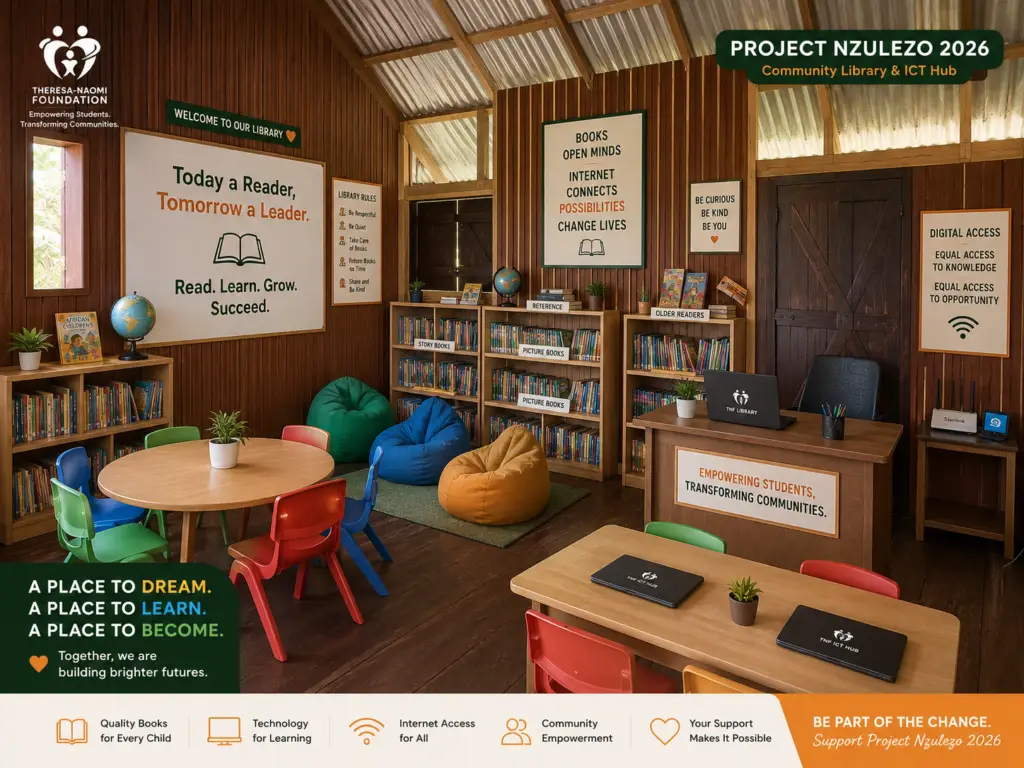
As we establish Community Libraries and ICT Hubs across rural Ghana, people occasionally ask why we continue investing in physical libraries when digital devices can seemingly provide unlimited information.
The answer is simple.
Libraries today are no longer just rooms filled with books. They are learning spaces.
Learning Is More Than Access to Information
The internet gives students access to millions of resources within seconds. Artificial Intelligence can answer questions instantly. Videos can explain complex concepts in minutes.
Yet learning is about much more than finding information.
Learning requires concentration.
Reflection.
Curiosity.
Critical thinking.
These are skills that are often best developed in calm, distraction-free environments where students can read, think and discuss ideas without constant digital interruptions.
This is one of the reasons several countries are re-evaluating the role of technology in education.
Sweden, for example, recently announced a significant investment in printed textbooks after studies linked excessive classroom screen use to declining reading comprehension, reduced concentration and weaker critical-thinking skills. Digital tools remain part of the classroom, but they are now viewed as complements rather than replacements for books.
We believe there is an important lesson in this.
Libraries Are Becoming Community Learning Centres
For TheresaNaomi Foundation, a modern library is much more than shelves of books.
It is a place where students can:
- Read quietly and develop a love for books.
- Research using both printed and digital resources.
- Study individually or collaboratively.
- Access computers and the internet.
- Learn digital skills.
- Attend reading clubs and mentorship sessions.
- Discover careers and opportunities beyond their communities.
In other words, the library becomes the heart of learning.
ICT Labs Are Not Replacing Libraries
Technology has transformed education in remarkable ways.
Students can now:
- Access world-class educational content.
- Learn coding and digital skills.
- Conduct research online.
- Connect with teachers and mentors worldwide.
- Explore virtual laboratories and simulations.
These opportunities are invaluable, especially for children in underserved communities.
However, technology works best when it supports strong learning habits rather than replacing them.
That is why every TheresaNaomi Foundation ICT Hub is designed alongside a library.
Books develop imagination.
Technology expands possibilities.
Together, they create confident, capable learners.
Building Spaces That Inspire Learning
When we say we are building Community Libraries and ICT Labs, we are not simply constructing rooms.
We are creating environments where children can discover new ideas, ask questions, solve problems and develop the confidence to shape their futures.
Some children will first discover the joy of reading through a storybook.
Others will write their first computer program.
Some will become teachers.
Others engineers, entrepreneurs, doctors or scientists.
Every journey begins with access to the right environment.
Our Vision
Through Project Nzulezo and future community initiatives, TheresaNaomi Foundation is committed to building integrated learning spaces where books, technology and community come together.
Because we believe the future of education is not choosing between libraries and ICT labs.
It is building learning spaces where both work together to unlock every child’s potential.
Wahab Nurudin Lartey
TheresaNaomi Foundation